



Table of Contents
What Is the Difference Between Vented and Non-Vented Safety Helmets?
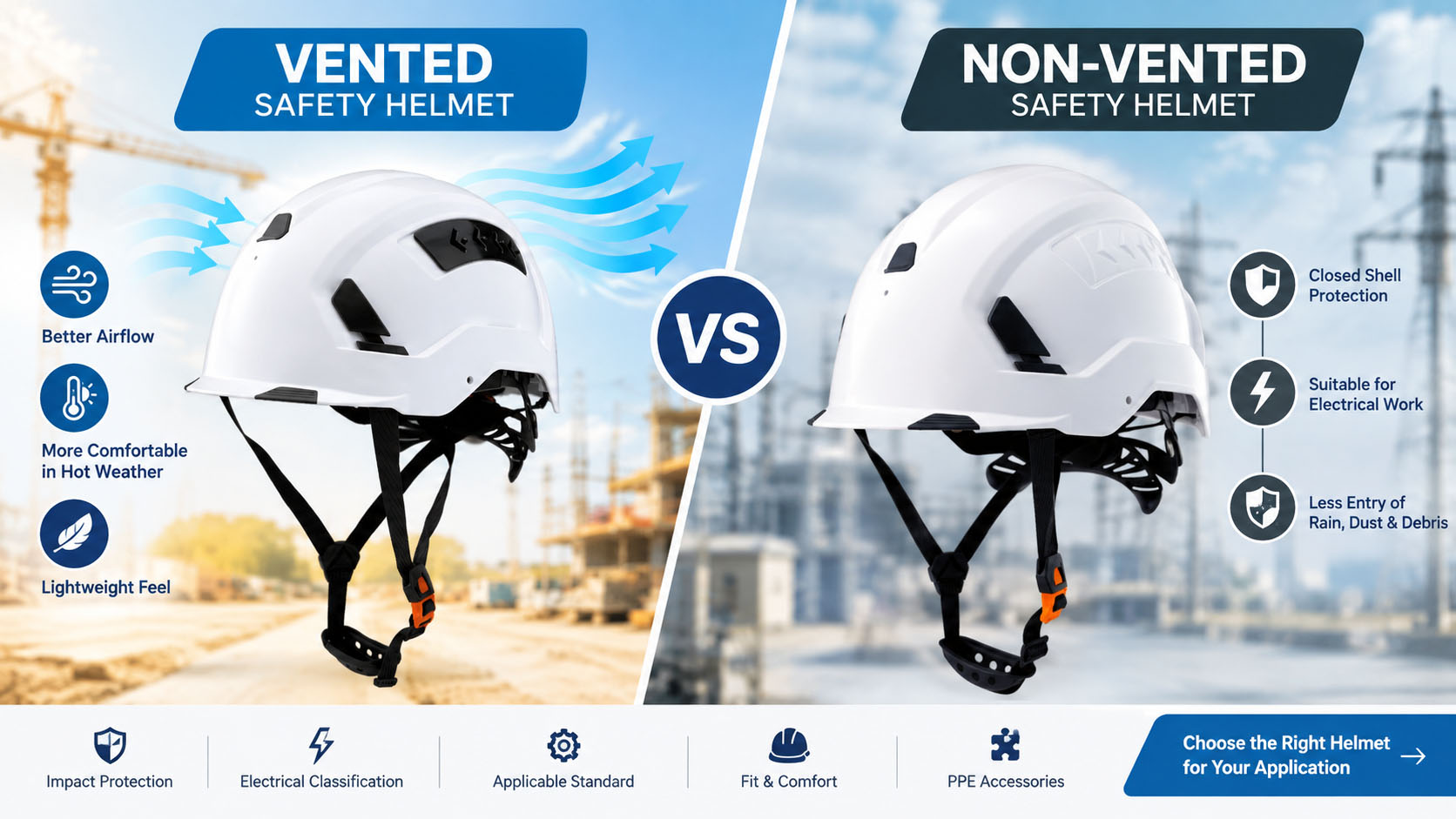
Vented safety helmets have openings in the shell to improve airflow, while non-vented safety helmets use a solid shell without ventilation openings. Vented models are generally preferred when airflow and hot-weather comfort are important, while non-vented models may be preferred when a closed-shell design is required for specific electrical or environmental hazards.
However, ventilation is only one factor in head protection. The right helmet also depends on the required impact protection, electrical classification, workplace hazards, applicable safety standard, fit, climate, and accessory compatibility.
In the U.S. market, the term hard hat is commonly used for industrial head protection, while safety helmet is widely used internationally. Both terms can describe industrial head protection products, but the applicable standard and certification should always be checked for the target market.
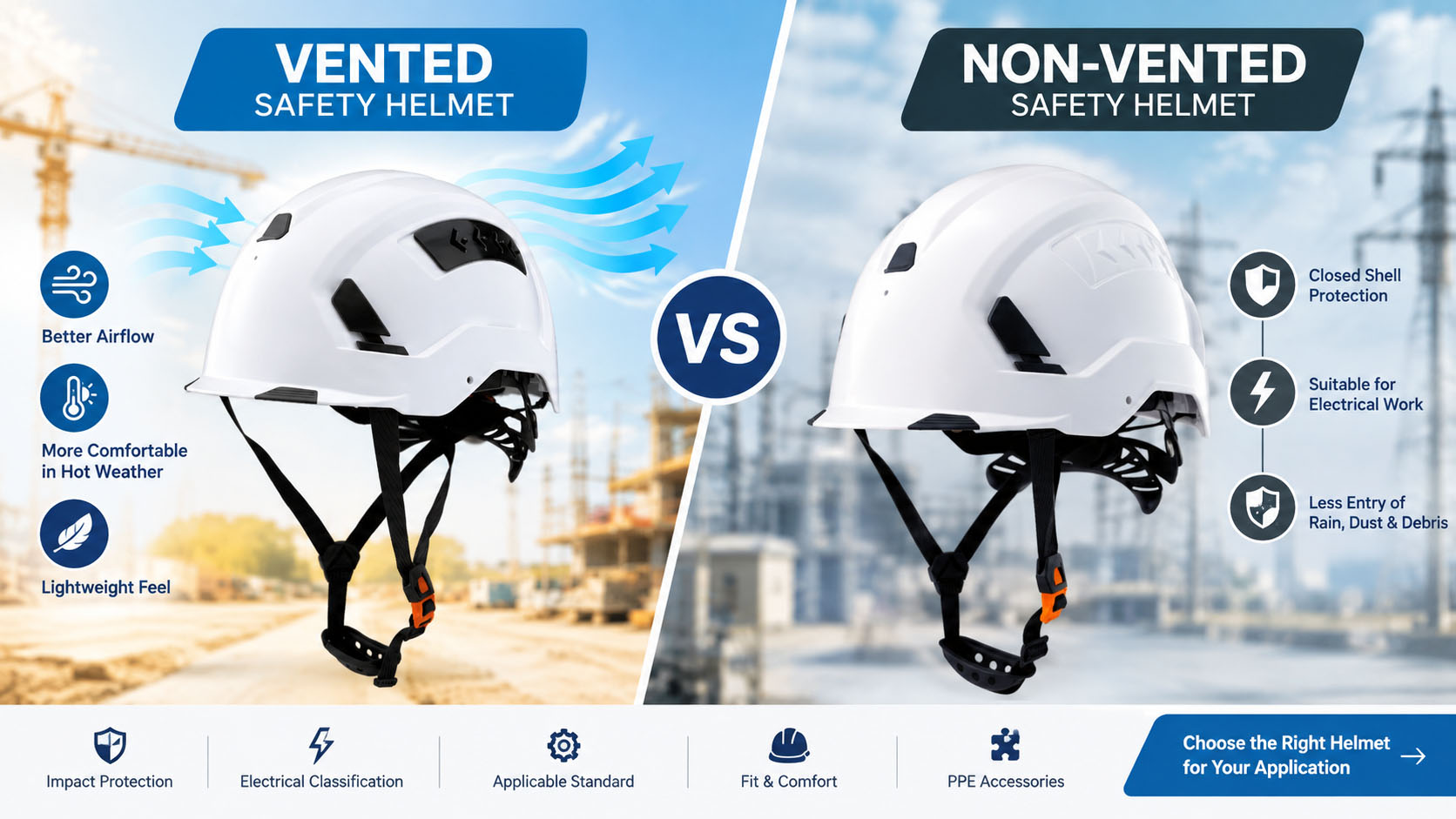
Vented vs Non-Vented Safety Helmet Comparison
Feature | Vented Safety Helmet | Non-Vented Safety Helmet |
|---|---|---|
Shell design | Ventilation openings | Solid shell |
Airflow | Higher | More limited |
Hot-weather comfort | Generally better | Generally lower |
Heat buildup | Reduced through airflow | More likely to retain heat |
Rain and water entry | More potential entry through vents | Fewer shell openings |
Dust and debris entry | More potential entry points | Fewer shell openings |
Electrical suitability | Depends on certification | Depends on certification |
Typical applications | General construction, outdoor work, maintenance | Electrical, utility, industrial and other controlled environments |
Main advantage | Airflow and comfort | Closed-shell design |
Key consideration | Workplace hazards | Workplace hazards and required certification |
Important: Vented does not automatically mean electrically unsuitable, and non-vented does not automatically mean electrically rated. Electrical protection must be confirmed from the helmet's actual certification, classification, markings, and documentation.
What Is a Vented Safety Helmet?
A vented safety helmet, often called a vented hard hat in the U.S. market, has openings in the shell that allow air to circulate around the wearer's head.
The primary purpose of ventilation is to improve airflow and comfort. During physically demanding work, heat and sweat can build up beneath a helmet. Ventilation openings can help move warm air away from the head and make the helmet more comfortable during extended use.
Vented designs can include fixed ventilation openings or adjustable ventilation systems, depending on the helmet model.
How Ventilation Works
Ventilation openings allow air to move through the shell and suspension area.
The actual cooling effect depends on several factors:
Vent size and location
Shell shape
Suspension design
Ambient temperature
Humidity
Wind and surrounding airflow
Physical workload
Length of the work shift
Therefore, a helmet with more ventilation openings does not necessarily provide better overall comfort than every other vented design.
Benefits of Vented Safety Helmets
Vented safety helmets can provide several advantages when ventilation is appropriate for the job:
Improved airflow around the head
Better comfort in hot weather
Reduced heat buildup
Greater comfort during long shifts
Improved wearer acceptance
Suitable for many outdoor applications
For construction, infrastructure, landscaping, surveying, maintenance, and other outdoor work without electrical exposure, ventilation can be an important comfort feature.
Limitations of Vented Safety Helmets
Ventilation openings can also create additional considerations in certain environments.
Depending on the design, vents may allow greater exposure to:
Rain and water
Dust and airborne debris
Liquid splash
Certain environmental contaminants
Electrical safety also requires particular attention. The shell material and ventilation design alone do not determine whether a helmet is suitable for electrical work.
Always verify the specific product's electrical classification and certification before using it around electrical hazards.
Where Are Vented Safety Helmets Commonly Used?
Vented helmets may be suitable for:
General construction
Road and infrastructure work
Outdoor maintenance
Landscaping
Engineering and surveying
Facility maintenance
Warehousing
General industrial work without electrical hazards
The final selection should always be based on the actual hazards and PPE requirements of the workplace.
What Is a Non-Vented Safety Helmet?
A non-vented safety helmet, also known as a non-vented hard hat, uses a solid shell without ventilation openings.
The closed-shell configuration can be useful in applications where reduced shell openings are desirable or where the helmet must meet specific electrical protection requirements.
Non-vented does not automatically mean electrically rated. Buyers should always check the actual product markings, certification, and technical documentation.
How the Solid Shell Provides Protection
A solid shell provides a more continuous barrier between the outside environment and the wearer's head.
This design can be beneficial when workers need head protection for electrical applications or environments where rain, liquid splash, dust, or other external conditions are important considerations.
The shell design, however, does not determine the helmet's complete protection level by itself.
Benefits of Non-Vented Safety Helmets
Non-vented safety helmets can offer:
Solid shell construction
Suitable designs for electrically rated applications
Fewer shell openings for rain and water entry
Reduced openings for dust and debris
Greater suitability for some industrial environments
Compatibility with a range of PPE accessories
For electrical applications, the key consideration is the helmet's actual electrical classification and certification, not simply whether the helmet is non-vented.
Limitations of Non-Vented Safety Helmets
The primary trade-off is reduced airflow.
Without ventilation openings, warm air has fewer paths to escape from inside the helmet. This can make a non-vented helmet feel warmer during physically demanding work in hot conditions.
Comfort can still be improved through:
Lightweight shell construction
Efficient suspension systems
Moisture-managing sweatbands
Adjustable headbands
Correct helmet fit
Suitable work-rest practices
Hydration and heat-management procedures
If a workplace requires an electrically rated helmet, ventilation should not be added simply for comfort unless the resulting design is properly tested and certified for the intended application.
Where Are Non-Vented Safety Helmets Commonly Used?
Non-vented helmets may be considered for:
Electrical work
Utility work
Power distribution
Industrial maintenance
Manufacturing
Chemical processing
Oil and gas operations
Mining
Wet or rainy environments
The exact helmet certification should always be matched to the target application and market requirements.
Vented vs Non-Vented Hard Hats for Electrical Work
Electrical hazards are one of the most important considerations when selecting head protection.
When workers may be exposed to electrical conductors, the helmet must provide the level of electrical protection required by the workplace and applicable regulations.
Why Electrical Hazards Change the Choice
Electrical hazards are different from ordinary impact hazards.
A helmet can provide effective impact protection but still be unsuitable for a workplace where electrical exposure is possible.
For this reason, buyers should not determine electrical suitability based only on:
Helmet material
Vented or non-vented design
Product appearance
General manufacturer descriptions
Instead, verify the helmet's specific electrical classification, certification, markings, and technical documentation.
Class E, Class G, and Class C
Electrical classification is a separate characteristic from Type I and Type II impact protection.
Classification | General Description |
|---|---|
Class E | Designed for electrical protection at the applicable level |
Class G | Provides limited electrical protection |
Class C | Conductive; does not provide electrical protection |
The exact requirements should be checked against the applicable edition of the relevant standard and the regulations for the target market.
The key principle is:
Ventilation describes helmet configuration. Electrical classification describes electrical performance.
These are not interchangeable characteristics.
Can You Use a Vented Hard Hat for Electrical Work?
Do not assume that a vented hard hat is electrically unsuitable solely because it has ventilation openings.
Likewise, do not assume that every non-vented hard hat provides electrical protection.
For electrical applications, verify the exact model's:
Electrical classification
Applicable standard
Certification
Product markings
Test documentation
Manufacturer instructions
The required protection should be determined through a workplace hazard assessment and the applicable regulatory or industry requirements.
Vented vs Non-Vented Safety Helmets for Hot Weather
Hot weather is one of the main reasons workers choose vented head protection.
When electrical or other hazards do not require a closed-shell configuration, ventilation can improve airflow and wearer comfort during outdoor work.
Why Vented Helmets Are More Comfortable in Hot Climates
Vented helmets allow air to circulate through the shell rather than trapping warm air beneath a solid shell.
This can improve comfort during:
Outdoor construction
Road work
Landscaping
Infrastructure projects
Maintenance
Long shifts in warm climates
The benefit can be especially noticeable when workers perform physically demanding tasks for several hours.
Heat Stress and Helmet Selection
Helmet ventilation can contribute to wearer comfort, but it should not be treated as the only control for heat stress.
Heat management may also involve:
Hydration
Rest breaks
Shade
Work-rest schedules
Appropriate clothing
Workload management
Acclimatization
Environmental monitoring
For this reason, a vented safety helmet should be considered one part of a broader heat-management strategy.
If the workplace requires electrical protection or another closed-shell configuration, the required safety performance should take priority over airflow.
Can Non-Vented Helmets Be Used in Hot Weather?
Yes.
Hot weather does not automatically mean that a vented helmet is the correct choice.
If the workplace requires electrical protection or another form of closed-shell protection, workers may need to use a non-vented design and address heat through other workplace controls.
Other comfort features can include:
Lightweight materials
Efficient suspension systems
Moisture-wicking sweatbands
Adjustable fit
Correct head size
Proper hydration
Scheduled rest periods
The goal is to balance protection, comfort, and workplace requirements.
How Weather and Workplace Hazards Affect Your Choice
Temperature is only one consideration when choosing between vented and non-vented head protection.
Rain, dust, chemical splash, sparks, welding, and other workplace hazards can also influence the appropriate helmet configuration.
Rain and Wet Conditions
A non-vented helmet has fewer shell openings, which can reduce direct water entry through ventilation holes.
For workers who frequently work in rain or wet conditions, a closed-shell design may therefore be preferable when it is compatible with the required protection.
Dust and Debris
Ventilation openings create additional pathways through the helmet shell.
In dusty environments, buyers may prefer a non-vented design when reducing shell openings is beneficial to the application.
A safety helmet is not, however, a substitute for respiratory protection. Where airborne contaminants create a respiratory hazard, appropriate respiratory PPE should be selected separately.
Chemical Splash
Chemical exposure requires consideration of the complete head and face protection system.
A non-vented helmet can reduce direct entry through shell vents, but chemical resistance depends on:
Chemical type
Concentration
Exposure route
Helmet materials
Accessories
Applicable PPE requirements
For chemical-processing environments, follow the relevant hazard assessment and manufacturer guidance.
Welding, Sparks, and Hot Work
Welding and hot work can involve several hazards, including sparks, heat, impact, and optical radiation.
A safety helmet alone does not replace task-specific welding or face protection.
Depending on the application, workers may also require:
Welding helmets
Face shields
Safety glasses
Hearing protection
Heat-resistant PPE
The safety helmet should therefore be selected as part of the complete PPE system.
Cold Weather
Ventilation can also influence comfort in cold or windy conditions.
In colder environments, workers may use compatible winter liners or other approved accessories to improve comfort.
Always verify compatibility between liners, hearing protection, face protection, chin straps, and the specific helmet model.
Does Ventilation Affect Type I and Type II Hard Hats?
No. Ventilation and impact type are separate characteristics of head protection.
Type I and Type II describe impact protection, while vented and non-vented describe the helmet's ventilation configuration.
A Type I or Type II helmet may be available in a vented or non-vented design, depending on the product and applicable certification.
Type I and Ventilation
Type I head protection is designed around the applicable requirements for protection against impacts to the top of the head.
Ventilation does not automatically determine whether a helmet is Type I.
A Type I helmet can therefore be designed with or without ventilation, depending on its construction and certification.
Type II and Ventilation
Type II head protection addresses top and lateral impact performance under the applicable standard.
Ventilation remains a separate design characteristic.
A Type II helmet may therefore also be available in a vented or non-vented configuration.
When choosing between Type I and Type II, focus on the foreseeable impact hazards first. Then determine whether ventilation is appropriate for the working environment.
For a detailed comparison of the two impact types, see our guide to Type 1 vs Type 2 Safety Helmets.
Which Safety Helmet Should You Choose?
The best way to choose between a vented and non-vented safety helmet is to start with the workplace hazard, not the helmet's appearance.
Work Environment | Recommended Direction |
|---|---|
Hot outdoor construction without electrical hazards | Vented safety helmet may be preferred |
General outdoor maintenance | Vented design may improve comfort |
Electrical work | Select a helmet with the required electrical classification |
Utility and power work | Consider electrically rated, application-appropriate head protection |
Frequent rain or wet conditions | Non-vented design may be preferred |
Dusty industrial environment | Consider whether reduced shell openings are beneficial |
Chemical splash risk | Evaluate helmet design together with appropriate face and chemical PPE |
Welding or hot work | Select application-specific head and face protection |
Mixed or uncertain hazards | Follow the workplace hazard assessment and required certification |
There is no universal design that is best for every workplace.
Choose a vented safety helmet when airflow and comfort are priorities and ventilation is compatible with the workplace hazards. Choose a non-vented helmet when a closed shell or specific electrical or environmental protection is required.
What Should Buyers Check Before Choosing a Vented or Non-Vented Helmet?
For distributors, contractors, safety managers, and industrial PPE buyers, helmet selection should go beyond shell color and appearance.
Identify the Workplace Hazards
Start with a workplace hazard assessment.
Consider:
Falling objects
Top impact
Lateral impact
Electrical conductors
Rain and water
Dust and debris
Chemical exposure
Welding and hot work
Temperature
Working at height
Other site-specific hazards
The helmet should be selected according to the hazards workers may reasonably encounter.
Check the Required Safety Standard
Confirm which standard applies to your target market and application.
Depending on the market and product type, buyers may encounter standards such as:
ANSI/ISEA Z89.1
EN 397
EN 12492
CSA Z94.1
GB 2811
Other regional or application-specific standards
The latest published edition of a standard and the edition referenced by a particular regulation are not always the same. Buyers should therefore confirm the applicable edition for their market and application.
Verify Electrical Classification When Needed
If electrical hazards are present, verify the helmet's electrical classification.
Do not assume:
Non-vented = Class E
or:
Vented = Class C
The actual certification and product markings should be checked.
Choose the Correct Impact Type
Determine whether the application requires Type I or Type II protection under the applicable standard.
Type I and Type II should be selected according to foreseeable impact hazards rather than the helmet's ventilation configuration.
Consider Climate and Working Hours
For hot outdoor work, evaluate:
Airflow
Shell weight
Suspension design
Sweatband
Head size adjustment
Shift duration
Physical workload
Ambient conditions
Comfort matters because a helmet that fits properly and remains comfortable throughout a shift is more likely to be worn consistently.
Check Suspension, Fit, and Accessories
A safety helmet is more than its outer shell.
Important purchasing parameters include:
Suspension configuration
Ratchet adjustment
Head size range
Chin strap
Sweatband
Face shield compatibility
Hearing protection compatibility
Safety eyewear compatibility
Headlamp compatibility
Other approved accessories
Confirm PPE Accessory Compatibility
If the helmet will be used with face shields, earmuffs, headlamps, chin straps, or other accessories, confirm compatibility with the specific model.
This is particularly important for B2B buyers who are purchasing complete PPE systems for construction, industrial, utility, or maintenance applications.
Safety Helmet Buyer Checklist for B2B Purchasing
For distributors and industrial PPE buyers, the following specifications can help streamline product selection and supplier communication.
Parameter | What to Confirm |
|---|---|
Helmet Type | Type I / Type II, as applicable |
Ventilation | Vented / Non-vented |
Electrical Class | Class E / G / C, if applicable |
Applicable Standard | ANSI/ISEA, EN, CSA, GB, etc. |
Shell Material | ABS, HDPE, PC, or other specified material |
Suspension | 4-point / 6-point or other configuration |
Head Size | Adjustable range |
Adjustment | Ratchet or other adjustment system |
Chin Strap | Included / optional |
Accessories | Face shield, earmuff, headlamp, eyewear, etc. |
Custom Color | Available colors and requirements |
Logo | Printing, label, molding, or other method |
Packaging | Standard or customized packaging |
MOQ | Minimum order quantity |
Sample | Availability and sample lead time |
Production | Manufacturing lead time and capacity |
For private-label and distribution programs, it is also useful to confirm packaging requirements, carton specifications, product markings, inspection requirements, and documentation before placing a mass-production order.
What Should You Ask a Safety Helmet Manufacturer?
When sourcing safety helmets directly from a manufacturer, buyers should confirm more than the product's basic specifications.
Key questions include:
Which safety standards does the helmet meet?
Is the helmet vented or non-vented?
What Type and electrical classification are available?
What head size range does the suspension support?
Which accessories are compatible with the helmet?
Can the shell color and logo be customized?
Can packaging be customized for private-label orders?
What is the MOQ for standard and customized products?
Are samples available before bulk production?
What are the sample and mass-production lead times?
What inspection and testing documents are available?
What production capacity is available for repeat orders?
These questions help distributors and PPE importers compare suppliers based on actual purchasing requirements rather than product appearance alone.
Common Mistakes When Choosing Vented vs Non-Vented Safety Helmets
Choosing a Helmet Based Only on Comfort
A cool and comfortable helmet is not necessarily the correct helmet for a particular hazard.
Comfort should be balanced with impact protection, electrical requirements, environmental conditions, fit, and certification.
Assuming All Non-Vented Helmets Are Electrically Rated
A solid shell does not automatically mean Class E or Class G.
Always verify the helmet's actual electrical classification and certification.
Assuming All Vented Helmets Have the Same Airflow
Two vented helmets can provide different levels of airflow.
Vent location, opening size, shell geometry, suspension design, and surrounding airflow can all affect wearer comfort.
Drilling Holes Into a Non-Vented Helmet
Never drill ventilation holes into a non-vented safety helmet unless the manufacturer specifically designs and approves the modification.
Changing the shell can affect the helmet's tested performance and certification.
If more airflow is required, choose a properly designed and certified vented model instead.
Choosing Without Checking Certification
A helmet may look suitable for a job but still fail to meet the required standard or classification.
For industrial and commercial purchasing, verify:
Applicable standard
Type
Electrical class
Certification
Product markings
Model number
Manufacturer documentation
Approved accessories
This is especially important for distributors and contractors supplying head protection to regulated markets.
Frequently Asked Questions About Vented and Non-Vented Safety Helmets
Are vented safety helmets cooler than non-vented helmets?
Generally, yes. Ventilation openings allow greater airflow through the helmet and can improve comfort in hot working environments. Actual cooling performance varies according to helmet design, climate, workload, and surrounding airflow.
Can you use a vented hard hat for electrical work?
Do not determine electrical suitability from ventilation alone. For electrical work, verify the exact helmet's electrical classification, certification, and product markings against the requirements of the application.
Are non-vented hard hats better for rain?
A non-vented hard hat has a closed shell and fewer openings, which can reduce direct water entry through ventilation holes. It may therefore be preferable for some wet-weather applications.
Are vented hard hats suitable for construction?
Yes. Vented hard hats can be suitable for many construction applications when their certification and protection level match the jobsite hazards. They can be particularly useful for general outdoor construction in hot weather when electrical protection is not required.
Can I drill holes into a non-vented hard hat?
No. Do not drill or otherwise modify a safety helmet unless the manufacturer specifically approves the modification. Altering the shell may affect its tested performance and certification.
Do Type II hard hats come in vented versions?
Yes. Type II impact protection and ventilation are separate characteristics. A Type II hard hat may be available in a vented or non-vented configuration depending on its design and certification.
Which safety helmet is better for hot weather?
A vented safety helmet is generally more comfortable for hot-weather work because it provides greater airflow. However, if the workplace requires electrical protection or another closed-shell configuration, the required hazard protection should take priority.
How do I choose between a vented hard hat and a non-vented safety helmet?
Start with the workplace hazards. Choose a vented design when airflow and comfort are priorities and ventilation is compatible with the application. Choose a non-vented design when the job requires a closed shell or specific electrical or environmental protection. Then verify the required standard, impact type, electrical classification, fit, and accessory compatibility.
Choose the Right Safety Helmet for Your Application
There is no single safety helmet that is ideal for every working environment.
Vented safety helmets are generally a strong choice when airflow, heat management, and long-shift comfort are important and the workplace hazards allow ventilation.
Non-vented safety helmets can be more appropriate when electrical protection, reduced shell openings, rain exposure, or other environmental considerations are important.
The most reliable approach is to match the helmet to the actual workplace hazards, required certification, impact type, electrical classification, climate, fit, and PPE system.
For distributors, contractors, industrial PPE suppliers, and private-label brands, ANT5PPE can provide OEM and ODM safety helmet solutions, including vented and non-vented designs, shell colors, logos, suspension systems, chin straps, packaging, and compatible accessories.
Request a Quote
Need vented or non-vented safety helmets for your market or application?
Contact ANT5PPE to discuss your safety helmet requirements, target market, certification needs, customization options, MOQ, samples, and bulk purchasing requirements.
RELATED BLOGS
-
 What Is the Difference Between Vented and Non-Vented Safety Helmets?Vented safety helmets have openings in the shell to improve airflow, while non-vented safety helmets use a solid shell without ventilation openings. Vented models are generally preferred when airflow and hot-weather comfort are impo
-
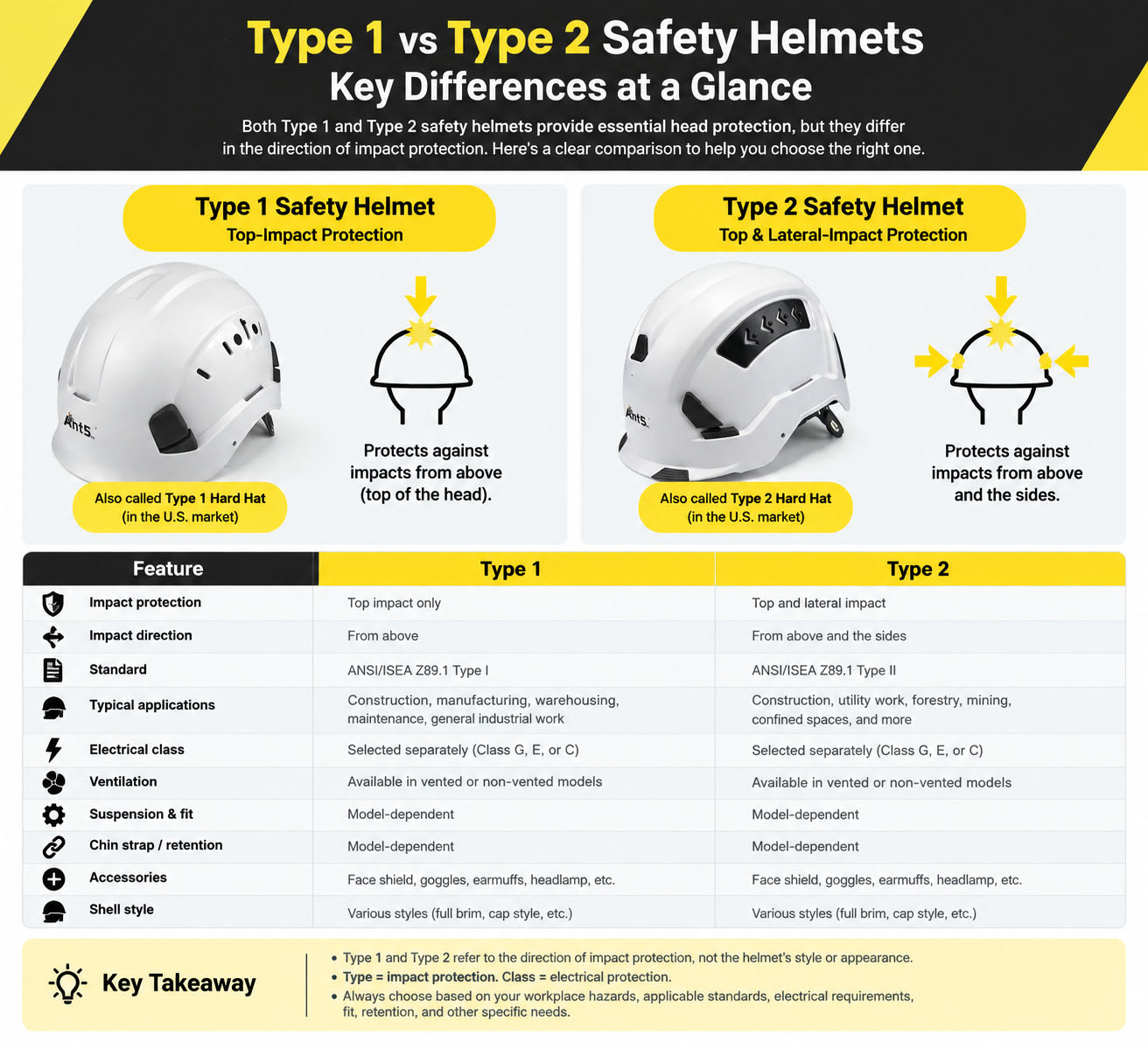 Table of ContentsToggleWhat Are Type 1 and Type 2 Safety Helmets?What Is a Type 1 Safety Helmet?What Is a Type 2 Safety Helmet?Type 1 vs Type 2 Safety Helmets: Key DifferencesType I vs Type II: How ANSI/ISEA Z89.1 Classifies Head ProtectionANSI/ISEA Z89.1-2014 and Existing Product SpecificationsWhat
-
 Table of ContentsToggleWhy Choose a Safety Helmet Manufacturer Serving the USA Market?How We Selected the Top Safety Helmet ManufacturersTop 15 Safety Helmet Manufacturers Serving the USA Market1. MSA Safety – USA2. Honeywell Safety – USA3. 3M Personal Safety – USA4. Bullard – USA5. Pyramex Safety –
