



Table of Contents
What Are Type 1 and Type 2 Safety Helmets?
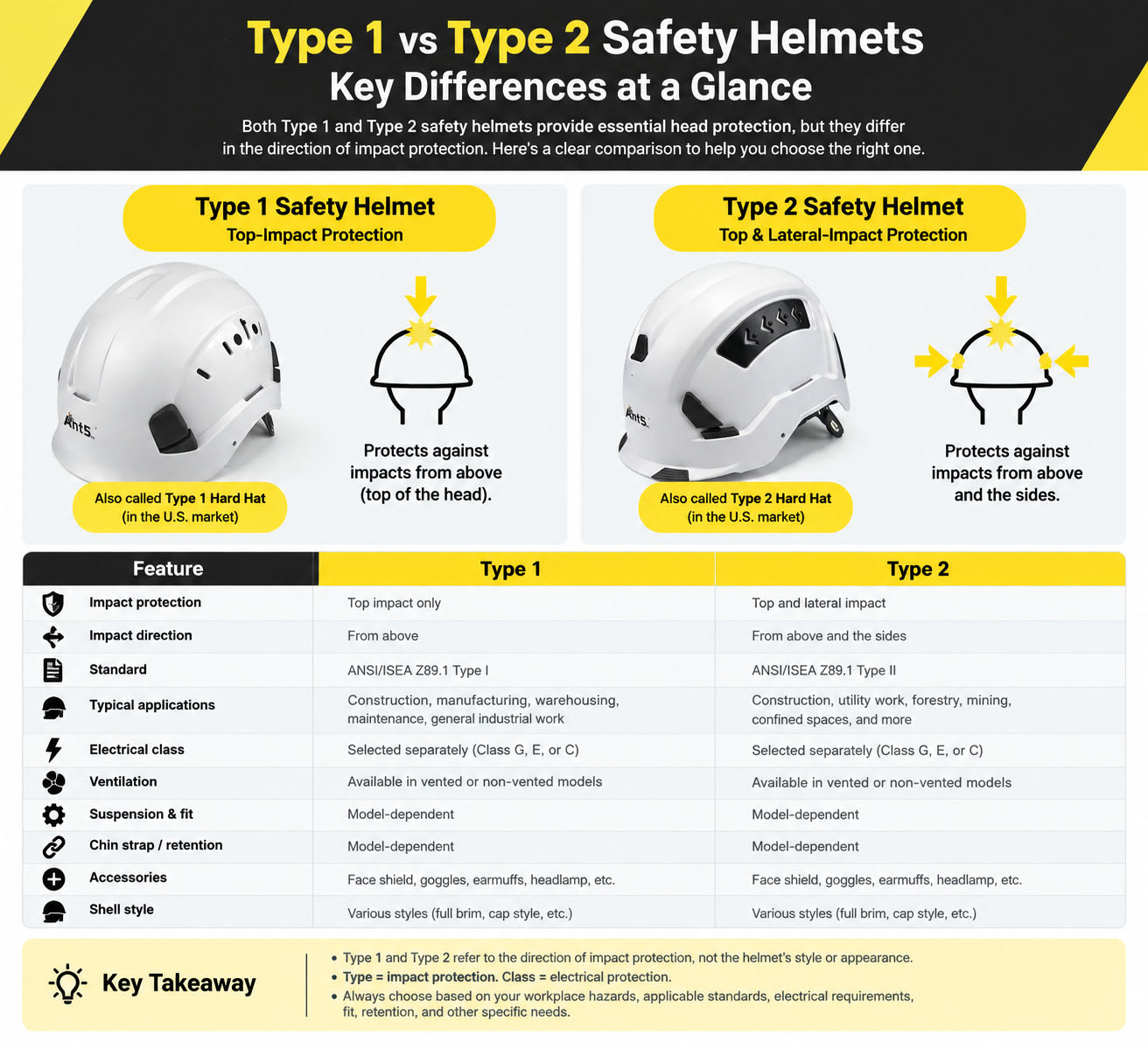
Type 1 and Type 2 safety helmets are industrial head protection products classified according to the direction of impact they are designed to address. In the U.S. market, these products are also commonly referred to as hard hats.
The main difference is straightforward:
Type 1 safety helmets are designed primarily for top-impact protection.
Type 2 safety helmets provide protection against impacts to both the top and sides of the head.
Under ANSI/ISEA terminology, these classifications are written as Type I and Type II. OSHA describes Type I as protection against a blow to the top of the head and Type II as protection against a blow to the top or sides.
For buyers, however, the Type classification is only one part of selecting industrial head protection. Electrical class, fit, retention, ventilation, accessories, work environment, and applicable certification requirements should also be evaluated.
What Is a Type 1 Safety Helmet?
A Type 1 safety helmet, also commonly called a Type 1 hard hat, is designed primarily to reduce the force of an impact to the top of the head.
Type 1 head protection may be appropriate when the main identified head-impact hazard comes from above, such as falling tools, materials, or objects.
Common applications can include:
General construction
Manufacturing
Warehousing
Maintenance
Industrial facilities
Material handling
Building and facility work
A Type 1 safety helmet can have different shell shapes, brim designs, suspension systems, ventilation configurations, and accessories. These features are separate from the Type classification.
What Is a Type 2 Safety Helmet?
A Type 2 safety helmet, also commonly called a Type 2 hard hat, is designed to address impacts to both the top and sides of the head.
Compared with Type 1 protection, Type 2 adds lateral-impact protection. This can be relevant in workplaces where workers may encounter impacts from multiple directions.
Potential applications include:
Construction
Utility work
Industrial maintenance
Forestry
Mining
Infrastructure projects
Work around moving equipment
Confined or congested work areas
Type 2 does not automatically determine whether a helmet is vented, non-vented, full brim, electrically rated, or compatible with specific accessories. These are separate product characteristics.
Type 1 vs Type 2 Safety Helmets: Key Differences
The easiest way to understand the difference between Type 1 and Type 2 safety helmets is to compare the impact protection they provide.
Feature | Type 1 | Type 2 |
|---|---|---|
Primary impact protection | Top impact | Top and lateral impact |
Impact direction | From above | From above and from the sides |
Lateral impact protection | Not the defining requirement | Included in the Type 2 classification |
Typical application | Workplaces primarily exposed to overhead impact | Workplaces with additional lateral-impact hazards |
Electrical class | Selected separately | Selected separately |
Ventilation | Model-dependent | Model-dependent |
Suspension | Model-dependent | Model-dependent |
Chin strap | Model-dependent | Model-dependent |
Shell style | Model-dependent | Model-dependent |
The key difference is therefore impact direction, rather than the appearance or style of the hard hat or safety helmet.
A full-brim design is not automatically Type 1, and a modern suspension system does not automatically make a helmet Type 2. The actual classification should be verified from the manufacturer's certification and product markings.
For B2B buyers, this distinction is important when comparing industrial safety helmets and hard hats from different manufacturers.
Type I vs Type II: How ANSI/ISEA Z89.1 Classifies Head Protection
ANSI/ISEA Z89.1 is the U.S. consensus standard associated with industrial head protection. It establishes performance requirements and classifications for protective helmets used in occupational applications.
The Type classification addresses impact protection, while the electrical Class addresses electrical performance.
OSHA's current Field Safety and Health Management System guidance references ANSI/ISEA Z89.1-2014 and describes Type I, Type II, Class G, Class E, and Class C head protection. OSHA defines Type I as reducing the force of an impact to the top of the head, while Type II addresses impacts to the top or sides.
In everyday product searches, buyers may therefore encounter both:
Type 1 / Type 2 safety helmets
Type 1 / Type 2 hard hats
Type I / Type II ANSI classifications
These expressions refer to the same basic Type classification system, with the Roman-numeral form commonly appearing in formal ANSI terminology and certification markings.
ANSI/ISEA Z89.1-2014 and Existing Product Specifications
ANSI/ISEA Z89.1-2014 remains important when reviewing existing U.S. safety helmet and hard hat specifications. OSHA's current public guidance still references the 2014 edition.
A product specification may, for example, state:
ANSI/ISEA Z89.1-2014 Type I Class C
or:
ANSI/ISEA Z89.1-2014 Type II Class E
In these markings:
Type I / Type II identifies the impact classification.
Class C / Class E identifies the electrical classification.
For buyers sourcing replacement products or comparing existing specifications, always check the exact certification marking and manufacturer's documentation.
What Is New in ANSI/ISEA Z89.1-2026?
ANSI/ISEA Z89.1-2026 is the newest edition of the industrial head protection standard.
According to ISEA, the 2026 edition maintains the familiar Type I and Type II classifications while introducing Type I+ and Type II+ designations for enhanced performance. It also expands impact testing for off-center and multidirectional hazards and adds requirements related to retention and stability, including standardized chin strap testing.
The basic Type distinction therefore remains relevant:
Type I: Top-impact protection
Type II: Top and lateral-impact protection
For procurement teams, the important point is to verify which edition and certification apply to the specific product being purchased rather than assuming that every product specification uses the newest edition.
Top Impact vs Lateral Impact Protection
Type 1 focuses primarily on top-impact protection.
Type 2 adds protection against lateral impacts as well as impacts to the top of the head.
Lateral impact can occur when a worker's head strikes a structure, piece of equipment, fixed object, or another surface from the side or at an angle. OSHA's selection guidance distinguishes Type II protection for situations where lateral impact is foreseeable.
The Type classification should therefore be selected according to the hazards of the work environment rather than the visual design of the helmet.
Type vs Class: What Is the Difference?
One of the most common points of confusion when comparing safety helmets and hard hats is the difference between Type and Class.
They describe two different aspects of protection:
Type = impact protection
Class = electrical protection
Understanding this distinction helps buyers interpret product specifications more accurately.
Type 1 and Type 2: Impact Protection
The Type designation describes the helmet's impact-protection classification.
Type 1: Top-impact protection
Type 2: Top and lateral-impact protection
In formal ANSI terminology, these are written as:
Type I
Type II
Therefore, Type 1 and Type I refer to the same basic Type classification, while Type 2 and Type II refer to the corresponding Type 2 classification.
Class G, Class E and Class C: Electrical Protection
Electrical Class is a separate specification.
Under the ANSI/ISEA classification system described by OSHA:
Electrical Class | General Description |
|---|---|
Class G | General electrical protection |
Class E | Electrical protection |
Class C | Conductive; no electrical protection |
OSHA's current guidance identifies Class G, Class E, and Class C and gives their associated electrical performance ratings.
Therefore:
Type 1 Class C
and
Type 2 Class E
describe two different combinations of impact and electrical protection.
The Type tells you about impact protection. The Class tells you about electrical performance.
This distinction is particularly important when sourcing industrial hard hats for construction, utility, manufacturing, and other specialized applications.
Type 1 vs Type 2 Hard Hats: Common Work Environments
The appropriate safety helmet or hard hat should be selected based on the hazards present in the workplace rather than simply the industry name.
OSHA identifies falling objects, impacts against fixed objects, and electrical hazards among the situations in which head protection may be required.
Common Applications for Type 1 Safety Helmets
Type 1 safety helmets may be suitable where top-impact hazards are the primary concern.
Common applications include:
General construction
Manufacturing
Warehousing
Maintenance
Industrial assembly
Material handling
Facility maintenance
General contractor operations
For these applications, buyers should still consider electrical classification, fit, suspension, ventilation, retention, shell material, and accessory compatibility.
Common Applications for Type 2 Safety Helmets
Type 2 safety helmets may be considered where lateral-impact hazards are also foreseeable.
Potential applications include:
Construction
Utility work
Industrial maintenance
Forestry
Mining
Infrastructure projects
Work around moving equipment
Confined or congested work areas
Certain elevated work environments
The same industry can require different types of head protection depending on the worker's task and specific hazard profile.
Does Type 2 Mean Better Protection?
Type 2 does not simply mean that a helmet is "better" for every application.
Type 2 provides an additional form of impact protection by addressing lateral impacts as well as top impacts. This additional protection can be relevant when side-impact hazards are foreseeable.
However, the appropriate helmet depends on the actual workplace hazards.
Other factors may include:
Impact direction
Electrical exposure
Helmet retention
Fit
Work at height
Ventilation
Environmental conditions
Compatibility with other PPE
Applicable certification requirements
ANSI/ISEA Z89.1-2026 is explicitly intended to help users make more hazard-based head protection decisions, including through the new Type I+ and Type II+ designations.
Instead of asking whether Type 2 is universally better, buyers should ask:
Which level of head protection matches the hazards of the job?
Vented vs Non-Vented Safety Helmets: Does It Affect Type 1 or Type 2?
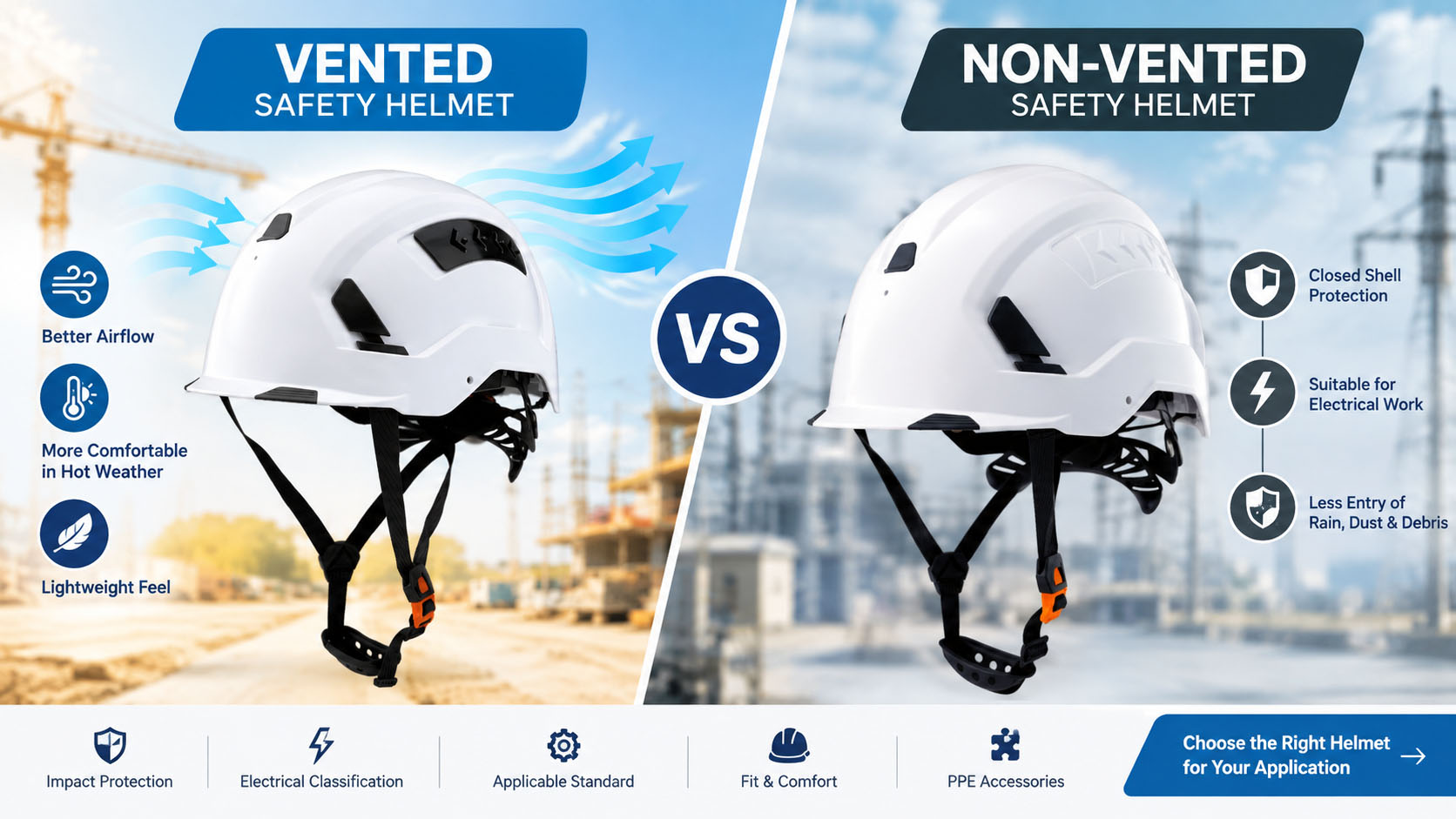
Ventilation is a separate design feature from the Type classification.
A Type 1 safety helmet can be vented or non-vented, depending on the specific product and certification. The same applies to Type 2 helmets.
Therefore:
Vented does not automatically mean Type 1.
Non-vented does not automatically mean Type 2.
Vented safety helmets may provide increased airflow and comfort in hot or physically demanding environments. However, ventilation should not be used to determine the helmet's impact classification.
Electrical suitability is a separate issue. For electrical applications, buyers should verify the exact product's electrical classification and certification rather than assuming that a vented or non-vented configuration is suitable.
OSHA's safety helmet guidance specifically states that vented hard hats or safety helmets cannot be used for electrical work.
For procurement teams, it is useful to treat these as separate specification fields:
Impact Type
Electrical Class
Ventilation
Shell Material
Suspension
Retention
Accessories
This makes it easier to compare industrial safety helmets and hard hats accurately.
Type 1 vs Type 2 for Working at Heights
Working at heights introduces additional considerations for head protection.
Workers using ladders, scaffolding, elevated platforms, towers, or other elevated work areas may need a helmet that remains securely positioned during movement.
A properly adjusted suspension system and suitable retention system can help keep the helmet in place. OSHA's safety helmet guidance discusses chin straps as a way to help keep head protection securely positioned during awkward positions or slips and falls.
However, working at height does not automatically mean that Type 2 protection is required.
The Type should still be selected based on the impact hazards identified for the particular work environment.
For climbing, rescue, and other specialized applications, buyers should also consider:
Helmet retention
Fit and adjustment
Chin strap configuration
Compatibility with other PPE
Applicable safety standards
Intended work environment
How to Choose Between Type 1 and Type 2 Safety Helmets
Choosing between Type 1 and Type 2 should begin with a workplace hazard assessment.
When Type 1 May Be Appropriate
A Type 1 safety helmet may be considered when:
The primary impact hazard comes from above.
Lateral-impact hazards are limited or not the primary concern.
The workplace specification calls for Type 1 protection.
The selected electrical Class matches the application.
The helmet provides suitable fit and retention.
The helmet is compatible with required PPE and accessories.
When Type 2 May Be Appropriate
A Type 2 safety helmet may be considered when:
Lateral-impact hazards are foreseeable.
Workers may experience impacts from the side as well as above.
The workplace specification calls for Type 2 protection.
The selected electrical Class matches the identified hazards.
Helmet retention is suitable for the work environment.
The helmet is compatible with other required PPE.
Other Factors to Check Before Buying
For B2B purchasing, Type should be only one item on the product specification checklist.
1. Applicable standard
Confirm the required standard, edition, certification, and markings for the target market.
2. Impact protection
Determine whether Type 1 or Type 2 protection is required based on the identified hazards.
3. Electrical classification
Check whether Class G, Class E, Class C, or another applicable electrical requirement is appropriate.
4. Fit and head size
Confirm that the suspension and adjustment range are suitable for the intended users.
5. Helmet retention
For work at height, climbing, rescue, or dynamic applications, consider whether a chin strap or other retention system is appropriate.
6. Ventilation
Select a vented or non-vented configuration based on the work environment and applicable certification requirements.
7. Accessories
Check compatibility with:
Face shields
Hearing protection
Headlamps
Communication systems
Other PPE
8. Work environment
Consider:
Heat and cold
Dust and moisture
Chemicals
Confined spaces
Outdoor exposure
Moving equipment
Electrical hazards
9. OEM and ODM requirements
For distributors and large-volume buyers, also consider:
Custom colors
Logo printing
Private labeling
Custom packaging
MOQ
Sample availability
Production lead time
A complete procurement decision should therefore evaluate Type, Class, certification, fit, retention, ventilation, work environment, and accessories together.
Type 1 vs Type 2 Safety Helmet FAQs
What is the difference between Type 1 and Type 2 safety helmets?
Type 1 safety helmets are designed primarily for top-impact protection, while Type 2 safety helmets provide protection against impacts to both the top and sides of the head.
What is the difference between Type 1 and Type 2 hard hats?
The basic distinction is the same: Type 1 hard hats focus on top-impact protection, while Type 2 hard hats address impacts to both the top and sides of the head.
In ANSI terminology, these classifications are written as Type I and Type II.
Is Type 2 better than Type 1?
Type 2 provides additional lateral-impact protection, but it is not automatically the appropriate choice for every workplace. Selection should be based on identified hazards, applicable requirements, electrical exposure, and work conditions.
Does Type 2 protect against side impacts?
Yes. Lateral or side-impact protection is a defining characteristic of Type 2 head protection. Type 1 focuses primarily on impacts to the top of the head.
Are Type 1 and Type 2 hard hats tested differently?
Yes. The classifications address different impact directions. Type 1 focuses on top impacts, while Type 2 includes additional lateral-impact protection.
The latest ANSI/ISEA Z89.1-2026 edition also introduces Type I+ and Type II+ designations with additional performance requirements.
What is the difference between ANSI/ISEA Z89.1-2014 and Z89.1-2026?
ANSI/ISEA Z89.1-2014 remains referenced in current OSHA guidance and is still common in existing product specifications. ANSI/ISEA Z89.1-2026 is the newest edition published by ISEA.
The 2026 edition maintains Type I and Type II classifications while introducing Type I+ and Type II+ designations and additional requirements related to impact, retention, stability, and other performance considerations.
Can Type 1 and Type 2 helmets have Class E protection?
Yes, depending on the specific product and its certification. Type and Class describe different characteristics: Type addresses impact protection, while Class addresses electrical protection.
Always verify the certification marking of the exact helmet model.
Can Type 1 safety helmets be vented?
Yes. Ventilation is separate from the Type classification. Type 1 helmets can be available in vented or non-vented configurations, depending on the product design and certification.
However, ventilation can affect electrical suitability, so the product's certification and intended application should always be checked.
Can Type 2 safety helmets be vented?
Yes. Some Type 2 helmets are available with ventilation. However, vented helmets should not be assumed to be suitable for electrical work. Verify the product's electrical classification and applicable requirements before use.
Is a chin strap required on a Type 2 safety helmet?
Not simply because a helmet is Type 2. Retention requirements depend on the applicable standard, product design, and work environment.
Chin straps may be particularly useful for applications involving awkward positions, elevated work, climbing, rescue, or increased movement. The 2026 ANSI/ISEA standard also includes standardized chin strap testing as part of its updated retention requirements.
Type 1 and Type 2 Safety Helmets: Key Takeaways
The key difference between Type 1 and Type 2 safety helmets is the direction of impact protection.
Type 1: Primarily addresses top-impact hazards.
Type 2: Addresses top and lateral-impact hazards.
Type I / Type II: The corresponding ANSI terminology.
Type: Describes impact protection.
Electrical Class: Describes electrical performance.
Ventilation: A separate helmet design feature, but it can affect suitability for electrical applications.
Retention: An important consideration for work at height and dynamic applications.
ANSI/ISEA Z89.1-2014: Still referenced in current OSHA guidance and common in existing product specifications.
ANSI/ISEA Z89.1-2026: The newest edition, maintaining Type I and Type II while introducing Type I+ and Type II+ performance designations.
Hard Hat: A common U.S. term for industrial protective headwear.
Selection: Should be based on workplace hazards, applicable standards, electrical requirements, fit, retention, and work conditions.
For PPE distributors, contractors, importers, and industrial buyers, comparing these factors together provides a more complete basis for selecting the appropriate industrial safety helmet or hard hat.
Looking for Type 1 or Type 2 Safety Helmets for Your Business?
If you are sourcing Type 1 or Type 2 safety helmets and hard hats for distribution, construction projects, industrial operations, or private-label programs, choosing the right Type is only the first step.
We can help you source industrial safety helmets based on your required:
Type 1 or Type 2 impact protection
ANSI/ISEA certification requirements
Electrical Class
Vented or non-vented configuration
Chin strap and retention requirements
Custom colors
Logo printing
OEM/ODM specifications
Private-label packaging
Order quantity and target market
Whether you need standard industrial safety helmets for regular procurement or customized hard hats for your own brand, our team can help review your specifications and develop a suitable product configuration.
Request a quote today with your required helmet type, certification, estimated quantity, target market, and customization requirements.
Request a Safety Helmet Quote
Tell us your requirements: Type 1 or Type 2, applicable standard, electrical Class, quantity, colors, logo, packaging, and OEM/ODM needs.
RELATED BLOGS
-
 What Is the Difference Between Vented and Non-Vented Safety Helmets?Vented safety helmets have openings in the shell to improve airflow, while non-vented safety helmets use a solid shell without ventilation openings. Vented models are generally preferred when airflow and hot-weather comfort are impo
-
 Table of ContentsToggleWhat Are Type 1 and Type 2 Safety Helmets?What Is a Type 1 Safety Helmet?What Is a Type 2 Safety Helmet?Type 1 vs Type 2 Safety Helmets: Key DifferencesType I vs Type II: How ANSI/ISEA Z89.1 Classifies Head ProtectionANSI/ISEA Z89.1-2014 and Existing Product SpecificationsWhat
-
 Table of ContentsToggleWhy Choose a Safety Helmet Manufacturer Serving the USA Market?How We Selected the Top Safety Helmet ManufacturersTop 15 Safety Helmet Manufacturers Serving the USA Market1. MSA Safety – USA2. Honeywell Safety – USA3. 3M Personal Safety – USA4. Bullard – USA5. Pyramex Safety –
